
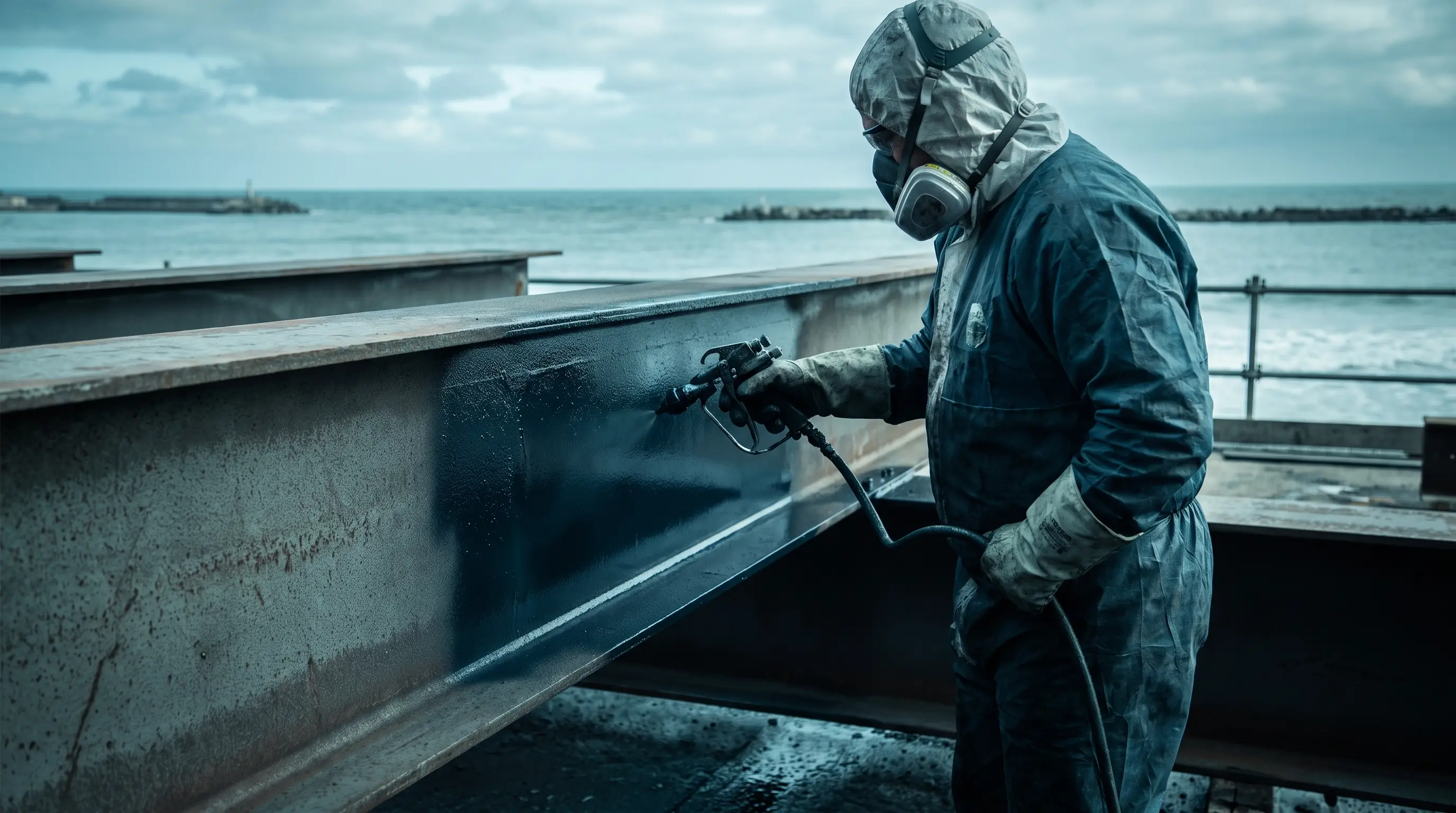
When a coating fails early, the product is usually blamed. In practice, the overwhelming majority of premature failures in coastal environments trace back to two things that happened before and during application: how the surface was prepared, and the conditions it was painted in.
Preparation determines the outcome
Adhesion is mechanical and chemical, and both depend on a clean, correctly profiled surface. Near the coast, the invisible problem is soluble salt. Chloride left on the steel draws moisture through the coating by osmosis and lifts it from beneath, regardless of how many coats were applied over the top.
- Wash down to remove soluble salts before blasting, and test chloride levels rather than assuming.
- Blast to the specified standard and confirm the surface profile with tape, not by eye.
- Apply the primer within the permitted window — blasted steel begins to flash-rust within hours in humid air.
- Remove all oil and grease before blasting, not after, or contamination is simply driven into the profile.
Every hour a blasted surface sits waiting for primer in coastal humidity is an hour of the coating’s life being spent before it is even applied.
Application conditions are part of the specification
Coatings cure within a defined envelope of temperature and humidity. Gulf summers routinely fall outside it. Steel in direct sun can exceed 70°C, which causes solvent to flash off far too quickly, leaving pinholes and dry spray. Overnight, the same steel can drop below the dew point and collect a film of moisture between coats.
- Measure substrate temperature, not just air temperature.
- Maintain at least 3°C above dew point during application and cure.
- Shift work to early morning or night during summer months and plan the programme accordingly.
- Respect the minimum and maximum overcoating intervals — exceeding the maximum can prevent inter-coat adhesion entirely.
Choosing the system
For structural steel in a coastal industrial environment, a zinc-rich primer with an epoxy intermediate and a polyurethane topcoat remains the dependable answer. The zinc provides sacrificial protection, the epoxy provides barrier thickness, and the polyurethane provides UV and colour stability.
Cutting the system to two coats to save money almost always costs more within five years. Where budget is genuinely constrained, it is better to reduce the coated area — prioritising the most exposed and least accessible steel — than to thin the system across everything.
Inspection makes the specification real
A specification that is never verified is a suggestion. Wet and dry film thickness readings, holiday detection on immersed or buried surfaces and adhesion testing on a representative sample give both parties confidence, and they cost a fraction of a repaint.
- Record wet film thickness during application, while correction is still possible.
- Confirm dry film thickness against the specified range — too thick is also a defect.
- Photograph and log each stage for the handover file.
Synergy carries out surface preparation and protective coating works across Muscat and the Sultanate, with inspection records issued as part of the deliverable. See our civil construction and painting services or ask us to look at a failing coating.