
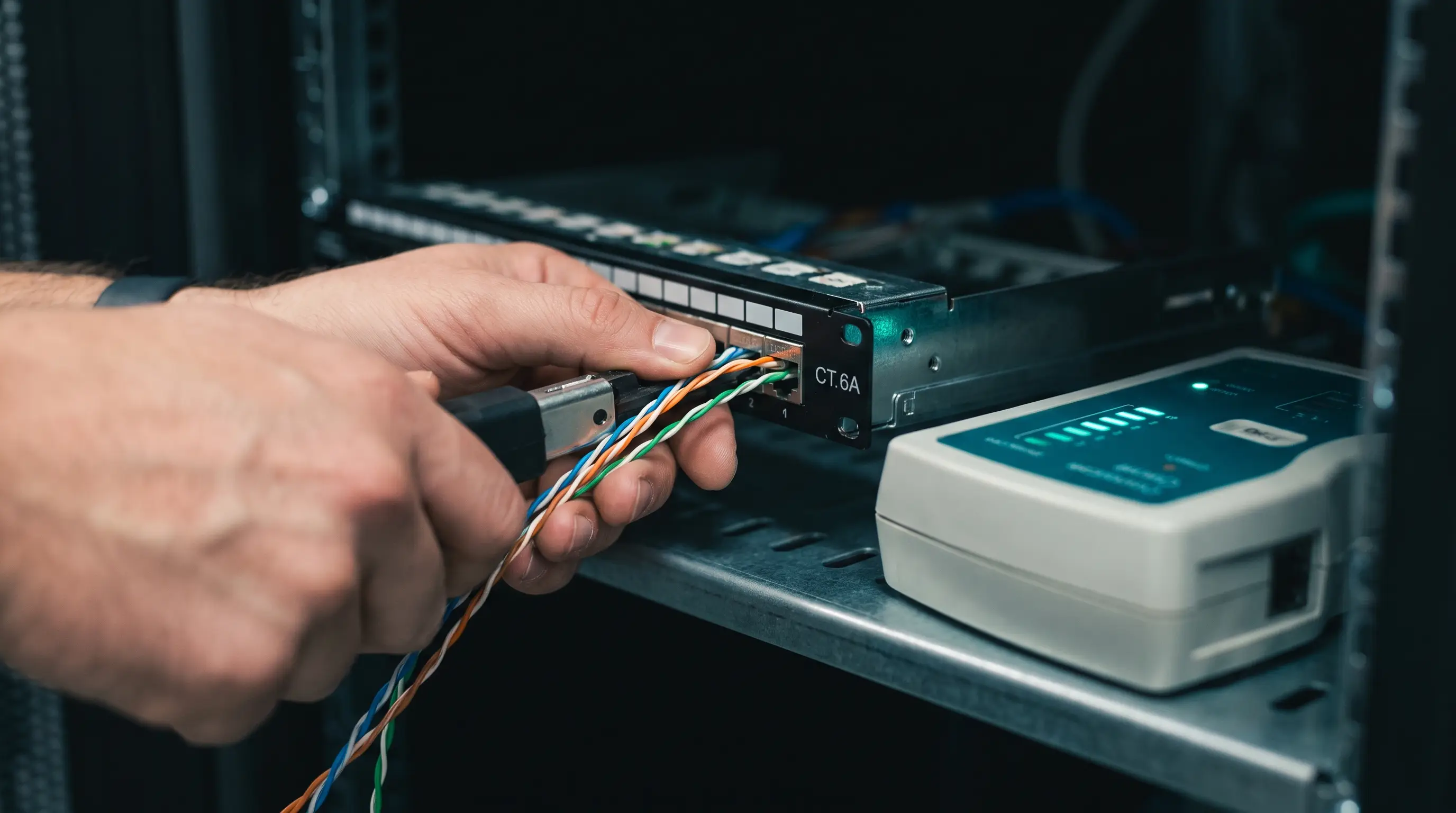
Network problems get blamed on equipment. In our experience, a large share of intermittent faults — the ones that are hardest to diagnose and most disruptive to the business — originate in the cabling nobody has looked at since it was installed.
The physical layer is the only part of the network that is expected to last fifteen years without being touched. It deserves more attention than it usually gets.
What certification actually proves
A cable that carries traffic is not the same as a cable that meets its standard. Permanent-link testing measures insertion loss, return loss, crosstalk and delay skew against the category specification, and it either passes or it does not.
The value shows up later. When a link begins dropping packets under load two years after handover, a test report from installation tells you immediately whether the cable was ever compliant — and that single fact usually collapses the diagnosis from days to minutes.
- Insist on per-outlet test results, not a sample or a blanket statement.
- Require results in the tester’s native report format, with the calibration date visible.
- Store the reports with the as-built drawings, not in an installer’s inbox.
Untested cabling is not cheaper. The cost is simply deferred to whoever has to troubleshoot it, usually at the worst possible moment.
Installation practice that quietly matters
Copper is unforgiving of handling. Exceeding the pulling tension stretches the twist and permanently degrades crosstalk performance. Tight bends do the same. Cable ties pulled hard enough to deform the jacket create a fault that will pass a quick test and fail under sustained load.
- Respect the minimum bend radius throughout, including inside the cabinet.
- Never exceed the manufacturer’s pulling tension — use lubricant and shorter pulls.
- Maintain separation from power cabling, and cross at right angles where crossing is unavoidable.
- Preserve the twist right up to the termination point.
- Use hook-and-loop, not tight nylon ties, on bundled data cable.
Labelling is documentation, not decoration
A rack where every port maps to a labelled outlet, and every outlet is on a drawing, transforms how quickly faults are resolved. It also removes the single largest risk in most small networks: that the only person who understands the cabling is the person who installed it.
Plan for what comes next
Cabling outlives three or four generations of active equipment. Specifying to today’s bandwidth is a false economy when the difference between categories is a small fraction of the installed cost, and when re-cabling an occupied building is disruptive and expensive.
- Allow spare capacity in containment and in the outlet count from the outset.
- Consider Cat6A where 10G to the desk or high-density wireless is plausible within the cabling’s life.
- Size the cabinet and its power and cooling for expansion, not for day one.
Synergy designs and installs structured cabling with certified per-outlet testing and full as-built documentation. See our IT networking and cabling services, or read about securing the network once it is live.