
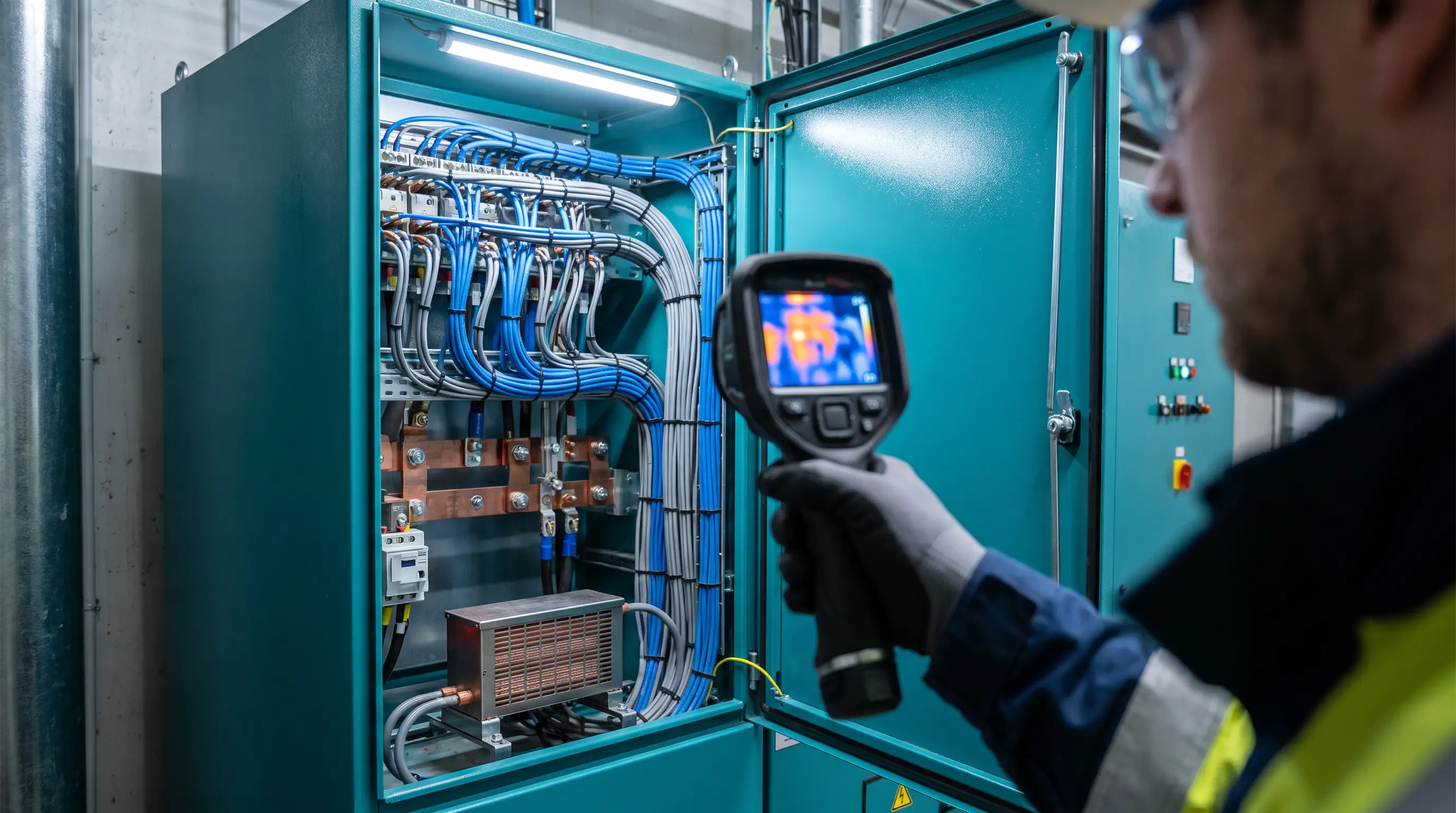
A switchgear nameplate is written for laboratory conditions. It assumes a 40°C ambient, clean air and a well-ventilated room. Very few plant rooms in Oman, the UAE or coastal India match that description in August, and the gap between the test certificate and the site reality is where most premature failures begin.
The good news is that every one of these factors is predictable and can be designed around at specification stage, when the cost of getting it right is a rounding error compared with an unplanned outage.
Derating for real ambient temperature
Circuit breaker current ratings fall as ambient temperature rises. A device rated 250 A at 40°C may only carry around 215–225 A in a 55°C enclosure, depending on the manufacturer’s curve. Inside a sealed panel standing in an unconditioned plant room, internal air can sit 10–15°C above the room itself.
This compounds quickly. Undersized breakers nuisance-trip in summer, which leads operators to replace them with larger devices — and now the discrimination study no longer holds, and the cable may be under-protected. The correct sequence is to establish the worst-case internal temperature first, then derate, then select.
- Measure or estimate the actual worst-month plant room temperature, not the design figure.
- Add the expected internal rise from panel losses — typically 10–15°C for a loaded assembly.
- Apply the manufacturer’s derating curve at that temperature, not at 40°C.
- Re-verify cable sizing and discrimination against the derated values.
The most expensive switchgear decision is rarely the panel you bought. It is the one you had to replace two summers later.
Ingress protection that matches the room, not the catalogue
IP54 is the reflexive answer for indoor panels, and it is frequently the wrong one. Fine airborne dust is a defining feature of the region, and it behaves differently from the test dust used for certification — it is finer, more abrasive and, near the coast, carries chloride.
Where panels sit in workshops, cement plants, quarries or open-sided buildings, IP55 or IP65 with filtered forced ventilation is usually the more economical choice across the asset life. Where conditioned air is available and reliable, a lower IP rating with good airflow can outperform a sealed high-IP panel that traps its own heat.
Humidity, condensation and the overnight cycle
Coastal humidity combined with a large day-night temperature swing produces condensation inside enclosures. Moisture settles on busbar supports and terminal blocks, and over time tracking and corrosion follow. Anti-condensation heaters with hygrostat control, correctly sized and actually commissioned, are inexpensive insurance that is routinely omitted or wired but never enabled.
- Specify anti-condensation heaters with hygrostat rather than thermostat-only control.
- Confirm at commissioning that heater circuits are energised and the setpoint is sensible.
- Use plated busbar and terminal hardware within a few kilometres of the coast.
- Include drain and breather fittings on outdoor kiosks.
Form of separation is a maintenance decision
Form 2, 3b and 4b are often treated as a price line rather than an operational choice. The real question is simple: will your team need to work on one outgoing circuit while the rest of the board remains live? If the answer is yes — and for most process and utility installations it is — then a higher form of separation pays for itself the first time it avoids a full shutdown.
What to ask your supplier
Before approving any panel drawing, four questions will surface most problems:
- At what ambient temperature are the quoted device ratings valid?
- What internal temperature rise is expected at full design load?
- Has the discrimination study been run at derated values?
- What routine tests will be performed and what certificates will be issued?
A supplier who can answer these without hesitation is a supplier who has thought about your site. One who cannot is quoting from a catalogue.
Synergy manufactures low and medium voltage switchgear in Muscat and routine-tests every assembly before dispatch. See our electrical switchgear and contracting services, or send us your single-line diagram for a second opinion on derating and form of separation.